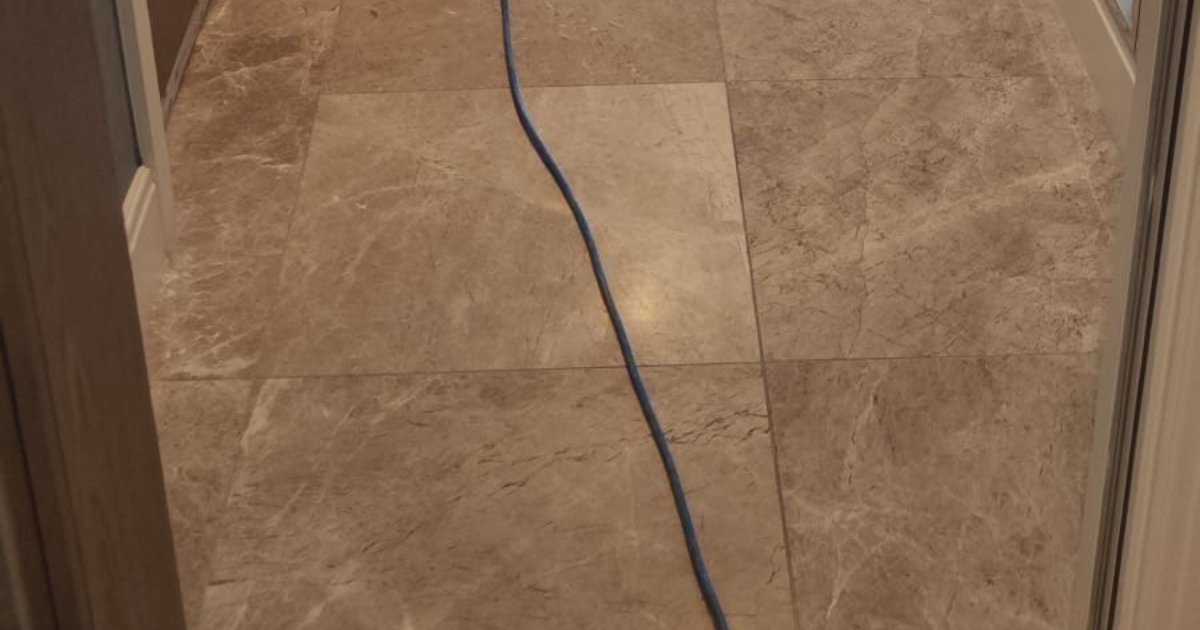
With travertine, you enjoy a high-end, timeless look which significantly enhances your property’s resale value. Plus you’ll love the unique character of this elegant natural stone. What’s more, its earthy tones complement myriad different interior design styles. Equally, it’s naturally heat and slip-resistant.
But, as with any material like this, a travertine floor needs regular, proper cleaning to stay looking its best. And you need to have huge control over what you’re doing at all times. That means thorough rinsing and not using so much water that you end up flooding the surface.
Why does travertine trap dirt?
Another potential issue can be when grit and soil enter the property, acting like sandpaper under shoes. Additionally, travertine’s honeycomb-style structure gives the material its glorious appearance. But this porosity means that regular mopping can just push dirty water further back into its natural holes.
So your floor can look grimy, even when you’ve just been cleaning it.
Has your travertine floor started to look dull?
Many homeowners find that their floor can start to look a little lifeless after a few years of use. But it’s important to understand that your flooring isn’t simply grubby. It has physically and chemically changed. Regular cleaning drills won’t work, since they don’t address travertine’s structural nature.
The reality is that, over time, if you live in a hard-water area and mop your floor with tap water, you leave a residue of microscopic limestone layers. This masks the natural lustre of the stone, so that the surface appears constantly dusty.
What you need to know before you start
If there are dark spots in natural holes in the stone, patchy soiling, gritty grout edges, or if it looks streaky when you’ve mopped, the answer is usually better pre-cleaning prep rather than stronger chemicals.
Have an acid-free, pH-balanced stone cleaner for a start. This leaves no residue in its wake, causes no etching and suits a damp mop.
The things to avoid include:
- Vinegar
- Citrus cleaners
- Ammonia
- Bleach
- Bathroom cleaners
The above can all harm natural stone surfaces, which are sensitive to acid, leaving behind patches which you won’t be able to remove. Pre-test your chosen cleaner in a concealed spot of your floor.
Why brush choice matters
With its unfilled holes and pitted surface, travertine needs the right brush choice. Think soft bristles, a soft brush attachment and a clean mop bucket. The main thing is to be as gentle with your travertine as you can; a soft brush provides light agitation. Meanwhile, a stiff one can just make your stone more vulnerable to damage.
Travertine cleaning step by step
It’s important to do a good job, since dirt water can stay in travertine holes even if the floor looks to be clean.
- Get furniture out of the way, clear dry grit and vacuum grout edges before you apply any water. Hopefully, you’ll already have mats in place to stop grit from causing damage in the first place. Bear in mind that, if you get grit wet, it can become an abrasive paste.
- Apply the cleaner but don’t flood the floor. You want to keep the surface damp long enough to loosen dirt without using so much water that liquid gets deep into the stone.
- If the floor appears clean while wet but dull again after drying, this is probably due to dirty rinse water settling back into the hollows in the travertine. Do a clean-water rins before drying thoroughly with old towels or allowing to air-dry.
The difference between surface wear and chemical etching
Physical surface wear occurs slowly in high-traffic spaces such as kitchens. Chemical etching happens when acidic products such as lemon juice, bleach and vinegar strip the surface of the stone on coming into contact with it. These marks look like water spots or mug rings, but don’t wipe away. They show where acid has eaten away at the surface, and so are not standard stains.
The four steps professionals take to restore lustre
Professional travertine cleaning typically involves four steps: deep cleaning and honing and then polishing and sealing.
It can be tempting to just go out and buy a cheap supermarket cleaner and hope for the best. But these items are typically sealants which sit on top of the surface like clingfilm without bonding with the stone. Within a couple of months at most, the layer begins to wear down. And that’s because these products attract grit and grime. So each time you add a new coat, you just bury dirt under a fresh layer. Over time, your floor gets grubbier and grubbier.
Not only that, but rectifying the damage caused can be expensive and time-consuming. But professional diamond polishing uses diamond-impregnated pads to smooth the surface and fix dull floors by closing up the stone’s pores. Dirt then has nothing to cling to, so your floor stays in a better condition for longer.
Keep it looking that way with daily dusting with a dry microfibre mop and weekly cleaning with a specialist pH-neutral stone cleaner and damp microfibre mop head. Finally, assess the integrity of your floor’s sealant every year. (If water beads on the surface, your sealant is working.)
Travertine cleaning from Royal Stone Care
Operating UK-wide, we at Royal Stone Care offer a diverse range of travertine services to our domestic and commercial customers, from travertine cleaning and restoration to sealing and repair.
Our team of experienced trained and qualified craftspeople really care about what they do and can offer a swift, efficient and effective service. Plus all work is done under a comprehensive guarantee.
Contact us today for a free quote and we’ll take it from there.
